

My TV stand used to look like a plate of black spaghetti had exploded behind it. Six cords, one overloaded power strip, and a dust bunny collection that could have qualified as its own ecosystem. I finally bought the D-Line Cable Management Box in January, mostly because I was tired of my three-year-old asking why there were so many snakes behind the TV. Three months later, I can tell you exactly what changed and what didn't, down to the parts nobody mentions in the five-star reviews.
This isn't a five-minute unboxing review. I've had this thing sitting on my living room floor, catching dust, surviving two kids and one very determined cat, since the second week of April. Here's what actually happened, not what the Amazon listing promised. I'm the kind of person who buys the cheap version of everything first, gets burned, then buys the version I should have bought in the first place, so I went in with fairly low expectations.
The Quick Verdict
It genuinely hid the cord chaos and stayed put for three months, but the vents get dusty fast and you'll want the bigger size than you think you need.
Amazon Check Today's Price →Tired of explaining the cord pile to houseguests?
The D-Line box swallowed my power strip, six cords, and a router in one shot. It's still sitting there, still doing its job, three months later.
Amazon Check Today's Price on Amazon →How I've Used It Behind My TV Stand
My setup is nothing special. A low media console, a wall-mounted TV, and a power strip feeding a Roku, a soundbar, a gaming console, a lamp, and a modem that has to sit on the floor because the cable jack is low on the wall. Before the box, all of that ran in a loose tangle across the carpet, half hidden by the console and half not, depending on how lazy I'd been that week. My husband used to joke that our living room had its own wildlife, and he wasn't entirely wrong.
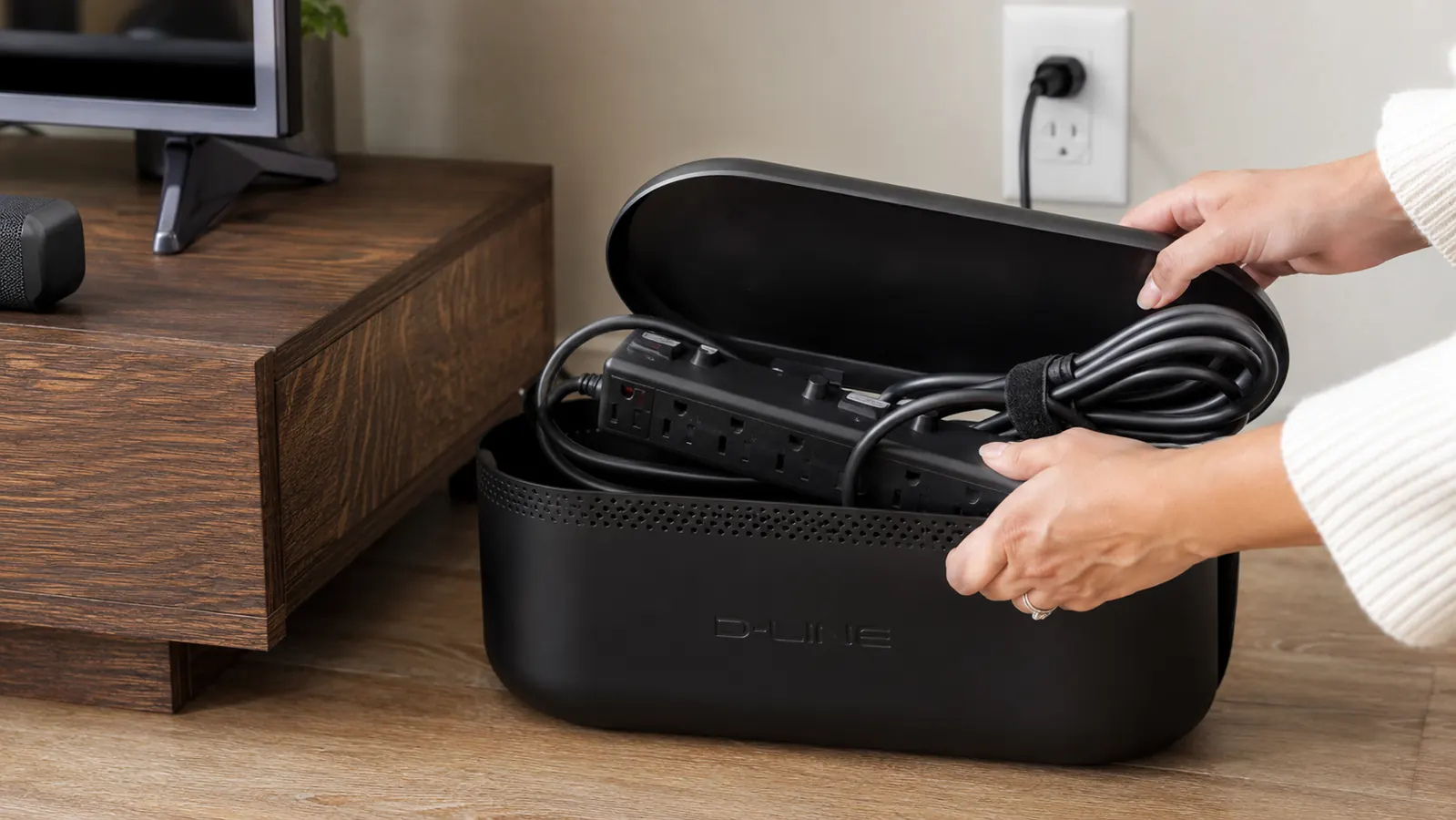
I bought the medium size, about 15 inches long, because I measured my power strip first and gave myself two extra inches of breathing room. That turned out to matter. I fed the power strip cord and the modem cord through the cutouts on the back, coiled the extra slack loosely instead of jamming it in, and snapped the lid shut. The whole setup took maybe ten minutes, most of which was me rearranging cords so nothing was pinched under the lid. I did it on a Sunday afternoon while the kids napped, which tells you how low-effort this actually was.
I didn't do anything fancy. No velcro ties, no labeling, no cable sleeves. I just wanted the visible mess gone, and I wanted to be able to lift the lid in thirty seconds when I inevitably need to unplug something to reset the router. That last part matters more than it sounds like it would, because I reset that router at least once a month, usually at the exact moment I'm trying to stream something for the kids and don't have patience for a fifteen-step process.
What's Actually Inside the Box
The material is a rigid, slightly flexible ABS plastic, the kind that doesn't feel cheap when you pick it up but also isn't going to double as a step stool. It has a matte finish that reads as off-white or light gray depending on the light, and it does not look like a piece of electronics packaging sitting in the middle of your living room, which was my biggest fear going in. I've owned plastic organizers before that scream 'garage storage bin,' and this doesn't have that vibe at all.
There are ventilation slots running along the top and sides, which the packaging makes a point of mentioning is for heat dissipation. I appreciated that more than I expected to, because I've had cheaper cord boxes before that turned into little plastic saunas for my power strip during summer. The D-Line box never felt warm to the touch even with five things plugged in and running most of the day, including a soundbar that tends to run hot on its own.
The lid has a soft click-close mechanism rather than a snap-tight seal, which means I can lift it one-handed while holding a laundry basket, which happens more often than I'd like to admit. The cutouts on each end are pre-scored, so you punch out only the ones you need, which kept my setup cleaner than a box with permanently open slots on all four sides. I only punched out two of the four cutouts, and the other two stayed solid, which I liked because it meant less dust getting in from angles I wasn't using.
Three Months In: Does It Still Look Good
This is the part most reviews skip, because most reviews get written the week the box arrives. Mine is written in July, after the box has sat on my carpet through a heat wave, a toddler's birthday party with roughly twelve small children stomping past it, and ninety-something loads of laundry carried directly over the top of it on the way to the dryer.
The lid still closes flush. That surprised me, because the cheap version I owned two years ago started warping at the seams by month two, popping open at one corner no matter how I positioned it. This one hasn't budged. The color has held too, no yellowing along the top even though it sits directly under a west-facing window that gets brutal afternoon sun in the summer, the kind of sun that has already faded one corner of our rug.
The vents are where it shows its age. Dust collects in those slots the same way it collects on a box fan, and I've had to vacuum the top with the brush attachment about once every two weeks to keep it from looking gray instead of white. It's a five-minute chore, but it is a chore, and nobody warned me about it before I bought it. If you're someone who already has a weekly tidy-up routine, this just becomes one more line item. If you don't, it'll sneak up on you.
The Cat Problem Nobody Warns You About
My cat, Biscuit, treated the old cord pile like a personal chew toy for years. I genuinely bought this box half hoping it would solve that problem, and mostly it did. She can't get her teeth on anything now, since everything is sealed inside rigid plastic, and I haven't found a single new bite mark on any cord since the day I installed it.
What she can do is sit on top of it. It's the perfect height and the perfect width for a cat who wants a window-adjacent perch, and the flat lid handles her weight fine, no cracking or bowing even after three months of daily naps. I don't mind this, but if you have a cat who scratches everything in sight, know that the matte finish shows light scuff marks where claws catch it, even though it hasn't actually torn or gouged the surface.
The other tradeoff is size planning. I measured my power strip before buying, but I didn't account for how much extra slack I'd end up coiling inside from the modem cord, which runs a longer path than I expected along the baseboard before it reaches the box. It fits, but it's snug, and there have been a couple of times I've had to press down gently to get the lid to click. If you're on the fence between two sizes, size up. An extra two or three inches of box costs you almost nothing in footprint and saves you from wrestling the lid shut every time you add a device.
Other Options I Considered First
Before I bought this, I looked at the fabric cord sleeves that zip around a bundle of wires. Those work fine for cords running along a baseboard, but they don't do anything for a power strip itself, which just sits there exposed, usually still visible from the couch. I also looked at a cheaper unbranded plastic box on Amazon that had almost identical photos to this one but a third of the reviews and no ventilation slots at all. I passed on it because I'd already been burned once by a similar box that got warm enough to worry me, and a warm plastic box sitting on carpet is not a risk I was willing to take twice.
I also thought about just running everything through a cord channel mounted to the wall behind the TV. That's a better long-term solution if you're willing to drill holes and commit to a permanent install, and honestly it looks cleaner in the after photos I've seen online. I wasn't willing to go that route, mostly because we rent and I didn't want to patch drywall when we move, and partly because I wanted something I could set up in one afternoon without a trip to the hardware store. The box was the answer for someone who wants the mess gone today, not a weekend project.

Was It Worth It
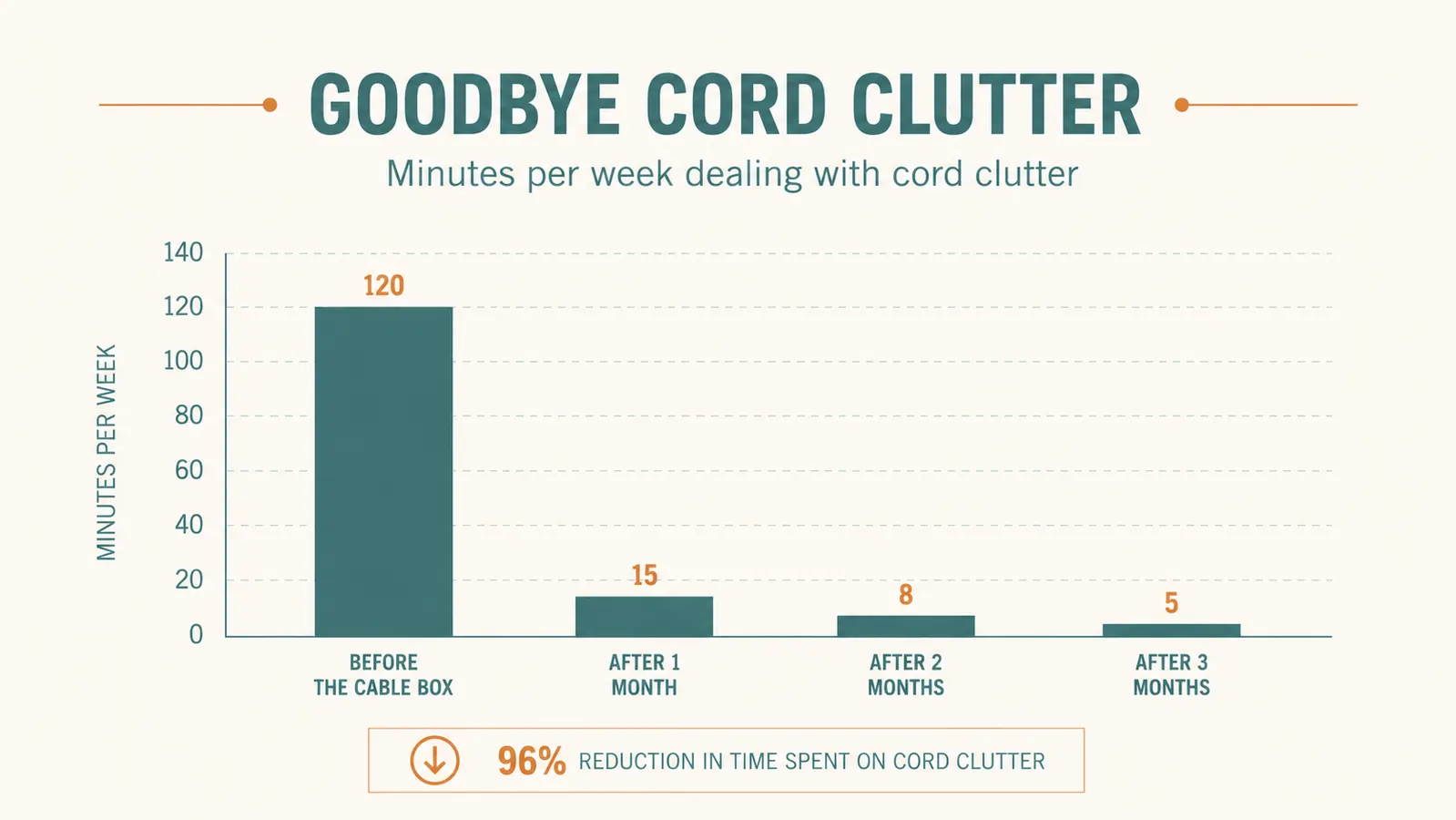
I checked today's price again while writing this, and it still lands squarely in the range I'd expect to pay for something that solves a problem I'd been complaining about for two years straight. Compared to the cord channel system, which would have run me more once you factor in mounting hardware, and compared to the wasted afternoons I spent re-coiling cords by hand every few weeks trying to make the mess look presentable for guests, this earned its spot back within the first month.
I don't think of it as a splurge item, more like the kind of small fix that quietly saves you time every single day without you noticing. I stopped doing the pre-guest cord scramble entirely. That alone made it worth having, before I even factor in what it did for the cat situation or the toddler questions.
What I Liked
- Hides a full power strip plus five or six cords in one shot
- Held its color and shape after three months in direct afternoon sun
- Lid lifts one-handed, easy to access for router resets
- Vented design kept the power strip from feeling warm
- Sturdy enough that my cat sits on top of it without issue
- No drilling or permanent install required, good for renters
Where It Falls Short
- Vents collect visible dust and need vacuuming about every two weeks
- Snug fit if you don't size up from your power strip's exact measurements
- Matte finish shows light scuff marks from cat claws over time
- No built-in cable ties inside, so loose cords can still shift when you open the lid
Three months in, the thing I notice most isn't the box itself. It's that I stopped noticing the cords at all.
Who This Is For
If you've got one main cluster of cords behind a TV, a desk, or a home office setup, and you want it gone without drilling into a wall or committing to a full cable-management overhaul, this is a genuinely easy win. It's especially good if you rent, if you have pets who treat loose cords like toys, or if you just want guests to stop asking what's going on back there. It's also a solid pick if you're the type who wants a Sunday-afternoon fix rather than a multi-step project spread across a weekend.
It's also worth it if you're someone who resets a router or swaps devices semi-regularly, since the lift-off lid means you're not fighting a permanent installation every time you need to plug something in.
Who Should Skip It
If you're managing a serious tangle, like a home entertainment center with ten or more devices, or a gaming setup with multiple consoles and a mess of HDMI splitters, one box probably won't cut it and you'll want to look at a wall-mounted channel system instead, or at minimum plan on buying two boxes rather than squeezing everything into one. And if dust maintenance sounds like a dealbreaker to you, know going in that the vents need occasional attention. It's not a set-it-and-forget-it-forever situation, more like a set-it-and-vacuum-it-monthly one.
Ready to stop stepping over cords every night?
Three months of daily use later, this is still the easiest fix I've found for a cluttered TV stand. Check today's price and see the current size options before you buy.
Amazon Check Today's Price on Amazon →